
Per- and polyfluoroalkyl substances (PFAS) are an emerging issue that all water providers and systems across the nation are working towards understanding. Fortunately, Medford Water’s water is at low risk and PFAS have not been detected in our system. Medford Water meets or exceeds all federal and state requirements for water quality testing, including PFAS.
What are PFAS?
PFAS are a group of human-made chemicals that have been manufactured and used in a variety of industries in the United States since the 1940s, and found in many consumer products like cookware, food packaging, and stain repellants. Manufacturing and processing facilities, airports, and military installations that use firefighting foams are some of the main sources of PFAS. Unfortunately, these compounds tend to break down extremely slowly over time, meaning they build up in the environment and in our bodies. Exposure to certain PFAS can lead to adverse human health effects; U.S. manufacturers have voluntarily agreed stop producing and using PFAS products by the end of 2025. U.S. Environmental Protection Agency (EPA) has additional facts about PFAS that can be read on their website.
Does Medford Water test for PFAS?
In addition to our regular monitoring the quality of the water supply, in 2024, we sampled for the 29 PFOS and PFOA compounds as well as lithium, as part of EPA’s 5th Unregulated Contaminants Monitoring Rule (UCMR5), a list of potential contaminants that public water systems must monitor for.
We have had no detections to date.
The results are published by EPA, in our Consumer Confidence Report, and in our Water Quality Analyses report, which is a comprehensive listing of all our annual testing results. Both reports are available on our Water Quality Reports page.
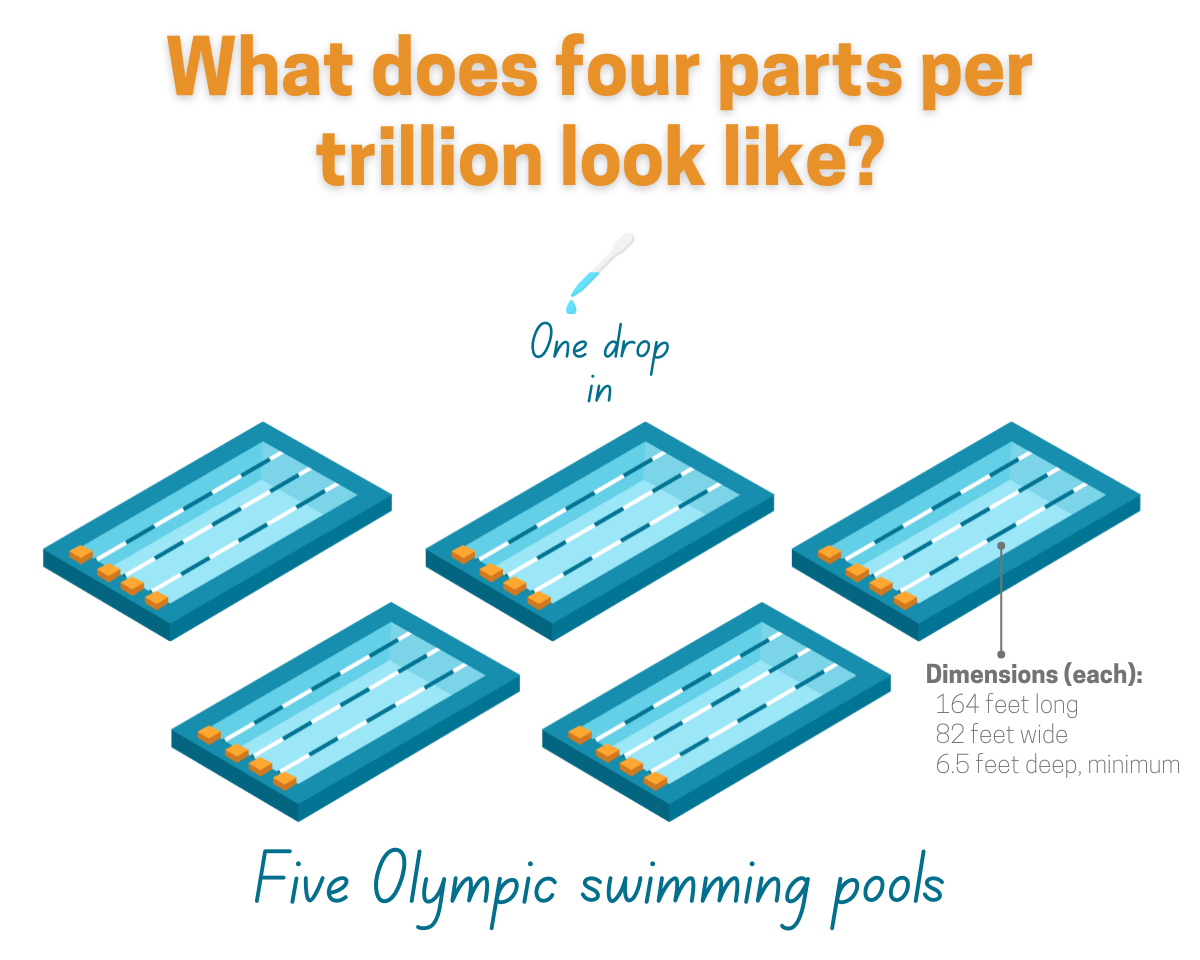
On May 14, 2025, the EPA clarified the rules and enforcement for PFAS compound, specifically regarding PFOA and PFAS. Current rules require drinking water suppliers to remove PFAS when it is detected at, or above, the maximum contaminant level (MCL) of 4.0 parts per trillion (ppt). While 4.0 ppt is an extremely small amount, the effects are cumulative over time. To help you understand what four parts per trillion is, imagine 1 ppt as 1 inch in 16 million miles (600+ times around the earth), or one cent in 10 billion dollars; we have also included a visualization at left. Learn more about the UCMR5 below or at EPA’s website.
What is Unregulated Contaminant Monitoring Rule 5?
The EPA is required to conduct data collection on potential contaminants that are not currently regulated. The potential contaminants list is updated every 5-years and released in the form of an Unregulated Contaminant Monitoring Rule (UCMR). The most recent of which was UCMR5. UCMR5 was focused on collecting date for PFAS and Lithium compounds in drinking water. The data collected helped the EPA to determine if unregulated contaminant in the UCMR5 were found in drinking water, what the related health risks are to the public, and if actions are needed to establish regulations and require removal. Medford Water was required to participate in the UCMR5 in 2024.
What is Medford Water doing to protect against PFAS?
The best way to maintain safe drinking water is to protect the source; find out more about our robust Source Water Protection Program here. Along with this program, we will continue to monitor our drinking water sources for contaminants such as PFAS to continue to bring you a reliable, high-quality water supply at the best value.
Questions?
Call us at 541-774-2430 or email customerservice@medfordwater.org.