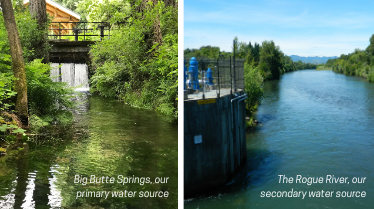
Medford Water works diligently to ensure that safe drinking water is available for the approximately 150,000 residents of the Rogue Valley that we serve, in Medford, Central Point, Eagle Point, Jacksonville, Phoenix, Talent, Ashland, the unincorporated community of White City, and the Elk City Water District. Our ability to supply water from two different sources helps to maintain reliability and redundancy: our primary source is Big Butte Springs, and the Rogue River is our secondary source used during peak demand months. Fortunately, it takes several years of compounded low precipitation and snow levels to impact these sources.
Find information about how we’re managing current water supply and demand, FAQs, area water supply conditions, what you can do to help, and additional resources on the tabs below.
- Medford Water Supply Updates
- Regional Water Conditions
- How you can help
- County Drought Status and Additional Resources
- Frequently Asked Questions
Medford Water’s Supply Management Updates
The table below will be updated throughout the summer season with information about how Medford Water is utilizing its water sources to reliably serve our customers clean drinking water in the most efficient and responsible way possible (it may be viewed better on a desktop browser). During the peak water demand months, demand is met through a combination of both of our sources.
| Date | Water Production | Water Demand (Use) | Customer Actions |
| September 14, 2026 | • Big Butte Springs (BBS): 19 MGD • Rogue River (via the Duff Drinking Water Treatment Plant): 19 MGD. 19 MGD is equal to 29.41 cfs, which is approximately 2.54% of the total river flows of 1,160 cfs. | • Current demand is 38 MGD; this is within the normal demand for September, which ranges from 35–40 MGD. • Demand is being met with a combination of Big Butte Springs and Rogue River sources | There is sufficient supply to meet the needs of the communities we serve. However, we urge all water users to be mindful of their usage as we go into the summer season. If you are interested in learning more ways to use water more efficiently, here are some helpful tips. |
| September 8, 2026 | • Big Butte Springs (BBS): 19 MGD • Rogue River (via the Duff Drinking Water Treatment Plant): 16 MGD. 16 MGD is equal to 24.77 cfs, which is approximately 1.61% of the total river flows of 1,540 cfs. | • Current demand is 35 MGD; this is within the normal demand for September, which ranges from 35–40 MGD. • Demand is being met with a combination of Big Butte Springs and Rogue River sources | There is sufficient supply to meet the needs of the communities we serve. However, we urge all water users to be mindful of their usage as we go into the summer season. If you are interested in learning more ways to use water more efficiently, here are some helpful tips. |
| August 31, 2026 | • Big Butte Springs (BBS): 19 MGD • Rogue River (via the Duff Drinking Water Treatment Plant): 28 MGD. 28 MGD is equal to 43.34 cfs, which is approximately 2.37% of the total river flows of 1,830 cfs. | • Current demand is 47 MGD; this is below the normal demand for August, which ranges from 48–52 MGD with peak demand spikes up to 55 MGD. • Demand is being met with a combination of Big Butte Springs and Rogue River sources | There is sufficient supply to meet the needs of the communities we serve. However, we urge all water users to be mindful of their usage as we go into the summer season. If you are interested in learning more ways to use water more efficiently, here are some helpful tips. |
| August 24, 2026 | • Big Butte Springs (BBS): 19 MGD • Rogue River (via the Duff Drinking Water Treatment Plant): 30 MGD. 30 MGD is equal to 46.44 cfs, which is approximately 2.55% of the total river flows of 1,820 cfs. | • Current demand is 49 MGD; this is within the normal demand for August, which ranges from 48–52 MGD with peak demand spikes up to 55 MGD. • Demand is being met with a combination of Big Butte Springs and Rogue River sources | There is sufficient supply to meet the needs of the communities we serve. However, we urge all water users to be mindful of their usage as we go into the summer season. If you are interested in learning more ways to use water more efficiently, here are some helpful tips. |
| August 17, 2026 | • Big Butte Springs (BBS): 19 MGD • Rogue River (via the Duff Drinking Water Treatment Plant): 31 MGD. 31 MGD is equal to 47.99 cfs, which is approximately 2.86% of the total river flows of 1,680 cfs. | • Current demand is 50 MGD; this is within the normal demand for August, which ranges from 48–52 MGD with peak demand spikes up to 55 MGD. • Demand is being met with a combination of Big Butte Springs and Rogue River sources | There is sufficient supply to meet the needs of the communities we serve. However, we urge all water users to be mindful of their usage as we go into the summer season. If you are interested in learning more ways to use water more efficiently, here are some helpful tips. |
| August 10, 2026 | • Big Butte Springs (BBS): 19 MGD • Rogue River (via the Duff Drinking Water Treatment Plant): 32 MGD. 32 MGD is equal to 49.54 cfs, which is approximately 3.28% of the total river flows of 1,510 cfs. | • Current demand is 51 MGD; this is within the normal demand for August, which ranges from 48–52 MGD with peak demand spikes up to 55 MGD. • Demand is being met with a combination of Big Butte Springs and Rogue River sources | There is sufficient supply to meet the needs of the communities we serve. However, we urge all water users to be mindful of their usage as we go into the summer season. If you are interested in learning more ways to use water more efficiently, here are some helpful tips. |
| August 3, 2026 | • Big Butte Springs (BBS): 19 MGD • Rogue River (via the Duff Drinking Water Treatment Plant): 31 MGD. 31 MGD is equal to 47.99 cfs, which is approximately 3.12% of the total river flows of 1,540 cfs. | • Current demand is 50 MGD; this is within the normal demand for August, which ranges from 48–52 MGD with peak demand spikes up to 55 MGD. • Demand is being met with a combination of Big Butte Springs and Rogue River sources | There is sufficient supply to meet the needs of the communities we serve. However, we urge all water users to be mindful of their usage as we go into the summer season. If you are interested in learning more ways to use water more efficiently, here are some helpful tips. |
| July 27, 2026 | • Big Butte Springs (BBS): 19 MGD • Rogue River (via the Duff Drinking Water Treatment Plant): 31 MGD. 31 MGD is equal to 47.96 cfs, which is approximately 3% of the total river flows of 1,510 cfs. | • Current demand is 50 MGD; this is within the normal demand for July, which ranges from 48–52 MGD with peak demand spikes up to 55 MGD. • Demand is being met with a combination of Big Butte Springs and Rogue River sources | There is sufficient supply to meet the needs of the communities we serve. However, we urge all water users to be mindful of their usage as we go into the summer season. If you are interested in learning more ways to use water more efficiently, here are some helpful tips. |
| July 20, 2026 | • Big Butte Springs (BBS): 19 MGD • Rogue River (via the Duff Drinking Water Treatment Plant): 31 MGD. 31 MGD is equal to 47.96 cfs, which is 3% of the total river flows of 1,530 cfs. | • Current demand is 50 MGD; this is within the normal demand for July, which ranges from 48–52 MGD with peak demand spikes up to 55 MGD. • Demand is being met with a combination of Big Butte Springs and Rogue River sources | There is sufficient supply to meet the needs of the communities we serve. However, we urge all water users to be mindful of their usage as we go into the summer season. If you are interested in learning more ways to use water more efficiently, here are some helpful tips. |
| July 13, 2026 | • Big Butte Springs (BBS): 19 MGD • Rogue River (via the Duff Drinking Water Treatment Plant): 29 MGD. 29 MGD is equal to 44.89 cfs, which is 2.97% of the total river flows of 1,510 cfs. | • Current demand is 48 MGD; this is within the normal demand for July, which ranges from 48–52 MGD with peak demand spikes up to 55 MGD. • Demand is being met with a combination of Big Butte Springs and Rogue River sources | There is sufficient supply to meet the needs of the communities we serve. However, we urge all water users to be mindful of their usage as we go into the summer season. If you are interested in learning more ways to use water more efficiently, here are some helpful tips. |
| July 6, 2026 | • Big Butte Springs (BBS): 19 MGD • Rogue River (via the Duff Drinking Water Treatment Plant): 28 MGD. 28 MGD is equal to 43.34 cfs, which is 2.66% of the total river flows of 1,630 cfs. | • Current demand is 47 MGD; this is below the normal demand for July, which ranges from 48–52 MGD with peak demand spikes up to 55 MGD. • Demand is being met with a combination of Big Butte Springs and Rogue River sources | There is sufficient supply to meet the needs of the communities we serve. However, we urge all water users to be mindful of their usage as we go into the summer season. If you are interested in learning more ways to use water more efficiently, here are some helpful tips. |
| June 29, 2026 | • Big Butte Springs (BBS): 19 MGD • Rogue River (via the Duff Drinking Water Treatment Plant): 23 MGD. 23 MGD is equal to 35.60 cfs, which is 1.99% of the total river flows of 1,790 cfs. | • Current demand is 42 MGD; this is within the normal demand for June, which ranges from 38–48 MGD • Demand is being met with a combination of Big Butte Springs and Rogue River sources | There is sufficient supply to meet the needs of the communities we serve. However, we urge all water users to be mindful of their usage as we go into the summer season. If you are interested in learning more ways to use water more efficiently, here are some helpful tips. |
| June 22, 2026 | • Big Butte Springs (BBS): 19 MGD • Rogue River (via the Duff Drinking Water Treatment Plant): 27 MGD. 27 MGD is equal to 41.80 cfs, which is 2.13% of the total river flows of 1,960 cfs. | • Current demand is 46 MGD; this is within the normal demand for June, which ranges from 38–48 MGD • Demand is being met with a combination of Big Butte Springs and Rogue River sources | There is sufficient supply to meet the needs of the communities we serve. However, we urge all water users to be mindful of their usage as we go into the summer season. If you are interested in learning more ways to use water more efficiently, here are some helpful tips. |
| June 15, 2026 | • Big Butte Springs (BBS): 19 MGD • Rogue River (via the Duff Drinking Water Treatment Plant): 25 MGD. 25 MGD is equal to 38.70 cfs, which is 1.44% of the total river flows of 2,690 cfs. | • Current demand is 44 MGD; this is within the normal demand for June, which ranges from 38–48 MGD • Demand is being met with a combination of Big Butte Springs and Rogue River sources | There is sufficient supply to meet the needs of the communities we serve. However, we urge all water users to be mindful of their usage as we go into the summer season. If you are interested in learning more ways to use water more efficiently, here are some helpful tips. |
| June 1, 2026 | • Big Butte Springs (BBS): 19 MGD • Rogue River (via the Duff Drinking Water Treatment Plant): 19 MGD. 19 MGD is equal to 29.41 cfs, which is 1.35% of the total river flows of 2,180 cfs. | • Current demand is 38 MGD; this is within the normal demand for June, which ranges from 38–48 MGD • Demand is being met with a combination of Big Butte Springs and Rogue River sources | There is sufficient supply to meet the needs of the communities we serve. However, we urge all water users to be mindful of their usage as we go into the summer season. If you are interested in learning more ways to use water more efficiently, here are some helpful tips. |
| May 27, 2026 | • Big Butte Springs (BBS): 19 MGD • Rogue River (via the Duff Drinking Water Treatment Plant): 12 MGD. 12 MGD is equal to 18.58 cfs, which is 0.85% of the total river flows of 2,180 cfs. | • Current demand is 31 MGD; this is within the normal demand for late-May, which ranges from 25–38 MGD • Demand is being met with a combination of Big Butte Springs and Rogue River sources | There is sufficient supply to meet the needs of the communities we serve. However, we urge all water users to be mindful of their usage as we go into the summer season. If you are interested in learning more ways to use water more efficiently, here are some helpful tips. |
| May 13, 2026 | • Big Butte Springs (BBS): 19 MGD • Rogue River (via the Duff Drinking Water Treatment Plant): 16 MGD. 16 MGD is equal to 24.77 cfs, which is 1.09% of the total river flows of 2,280 cfs. | • Current demand is 35 MGD; this is within the normal demand for mid-May, which ranges from 25–38 MGD • Demand is being met with a combination of Big Butte Springs and Rogue River sources | There is sufficient supply to meet the needs of the communities we serve. However, we urge all water users to be mindful of their usage as we go into the summer season. If you are interested in learning more ways to use water more efficiently, here are some helpful tips. |
| May 4, 2026 | • Big Butte Springs (BBS): 19 MGD • Rogue River (via the Duff Drinking Water Treatment Plant): 7 MGD. 7 MGD is equal to 10.83 cfs, which is 0.61% of the total river flows of 1,790 cfs. | • Current demand is 26 MGD; this is within the normal demand for early May, which ranges from 25–38 MGD • Demand is being met with a combination of Big Butte Springs and Rogue River sources | There is sufficient supply to meet the needs of the communities we serve. However, we urge all water users to be mindful of their usage as we go into the summer season. If you are interested in learning more ways to use water more efficiently, here are some helpful tips. |
| April 28, 2026 | • Big Butte Springs (BBS): 19 MGD • Rogue River (via the Duff Drinking Water Treatment Plant): 3 MGD. The drinking water plant has begun producing water as use increases. 3 MGD is equal to 4.64 cfs, which is 0.35% of the total river flows of 1,300 cfs. The timing of the plant’s startup is normal compared to previous years. | • Current demand is 22 MGD; this is within the normal demand in late April, which ranges from 17–25 MGD • Demand is being met with a combination of Big Butte Springs and Rogue River sources | There is sufficient supply to meet the needs of the communities we serve. However, we urge all water users to be mindful of their usage as we go into the summer season. If you are interested in learning more ways to use water more efficiently, here are some helpful tips. |
| April 22, 2026 | • Big Butte Springs (BBS): 19 MGD • Rogue River (via the Duff Drinking Water Treatment Plant): 0 MGD. The drinking water plant will begin producing water later this week as use has increased | • Current demand is 19 MGD; this is within the normal demand in April, which ranges from 17–25 MGD | We urge all water users to be mindful of their usage as we go into the summer season; there is sufficient supply to meet the needs of the communities we serve. |
| April 1, 2026 | • Big Butte Springs (BBS): 25 MGD using both pipelines; on April 20, we will transition from two full pipes to pipe-and-a-half, reducing this amount to approximately 19 MGD being brought from BBS • Rogue River (via the Robert A. Duff Drinking Water Treatment Plant): 0 MGD, the Duff Drinking Water Treatment Plant will start up this month to treat/produce water from the Rogue River; timing depends on how weather drives demand | • Current demand is 21 MGD; this is within the normal demand in April, which ranges from 17–25 MGD • Demand is being met with Big Butte Springs only | There is sufficient supply to meet the needs of the communities we serve. However, we urge all water users to be mindful of their usage as we go into the summer season. If you are interested in learning more ways to use water more efficiently, here are some helpful tips. |
| Definitions BBS: Big Butte Springs, which is brought to Medford approximately 30 miles from the slopes of Mt. McLoughlin. Duff: The Robert A. Duff Drinking Water Treatment Plant, where our secondary source the Rogue River is treated to supplement our drinking water. CFS: Cubic feet per second; a rate of water flow measurement representing one cubic foot of volume passing a given point in one second. MGD: Million Gallons per Day; a measure of water flow rates representing one million US gallons over a 24-hour period. MGD to CFS conversion: One MGD is equivalent to 1.5472 CFS. | |||
Snowpack
The National Resource Conservation Service monitors snowpack in stream basins. Currently, every basin across the state is measuring well below the historical median (min = 0%, max = 30%). Statewide Snow Water Equivalent in the Rogue-Umpqua Basin is measuring 0% of the historical median and is expected to remain there throughout the summer. Fortunately, it takes several years of compounded low snow levels to impact our water sources.
If you would like to see the levels across the state, go to the Natural Resources Conservation Service.
Precipitation
Precipitation in Medford is at 15.25 inches, approximately 31% below normal for the water year (October 1, 2025 to September 30, 2026). Fortunately, it takes several years of compounded low precipitation to impact our water sources.
This data is collected at the Rogue Valley International Airport; precipitation levels around the Rogue Valley will vary depending upon the location.
The National Weather Service has an in-depth map to reference as another resource.
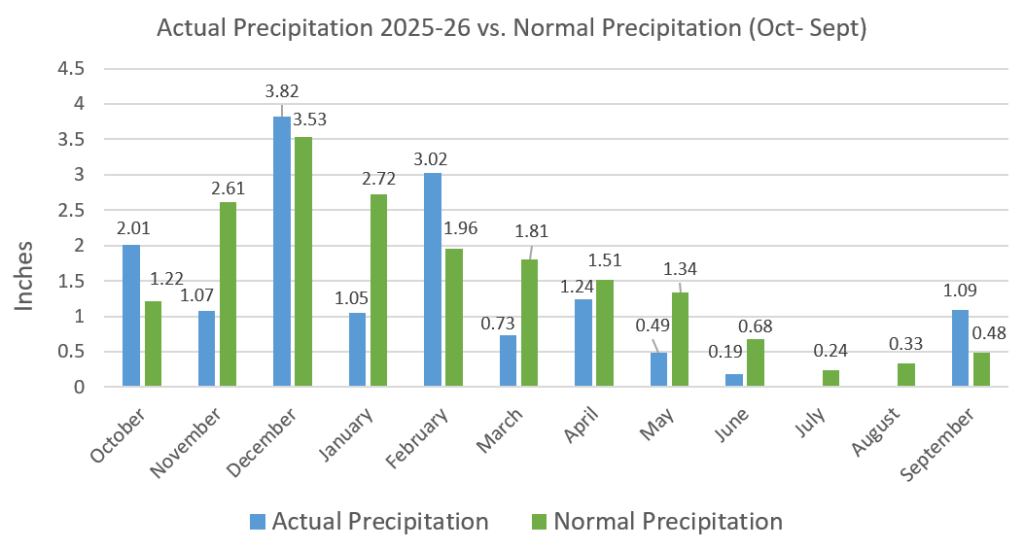
Source: Medford Water
Irrigation Reservoir Levels
Reservoir storage in most basins across the state are near to above normal for this time of year; below are reservoir levels in our region. The diagrams represent the level of fill in the reservoirs as both percent full and as a ratio of volume of water currently in the reservoir to the volume of water in the reservoir when it is full.
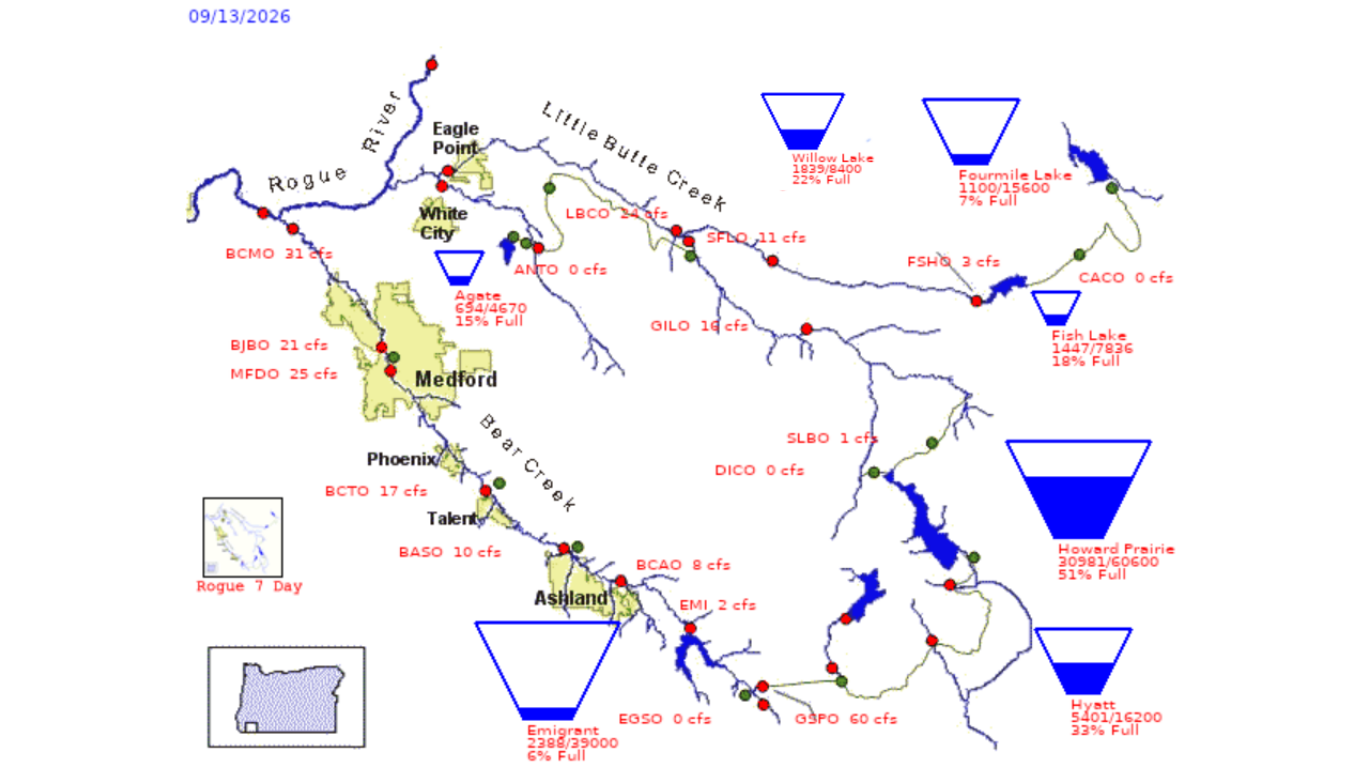
Source: US Bureau of Reclamation
While the reservoirs in the Bear Creek and Little Butte Creek Basins (pictured above) are primarily for irrigation, the reservoirs in the Rogue Basin (pictured below) are managed by the US Army Corps of Engineers, and are primarily for flood control and fish and wildlife conservation.
ROGUE BASIN TEACUP DIAGRAM
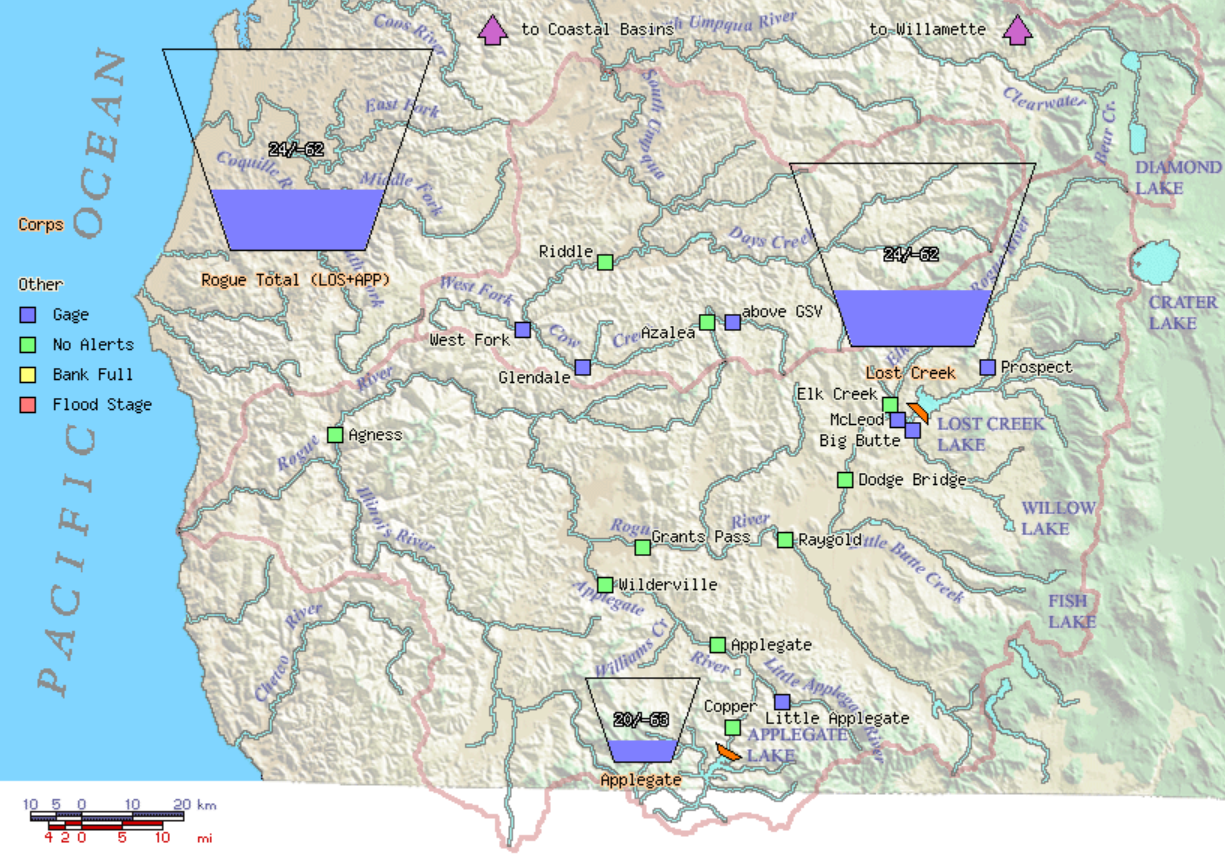
Source: US Army Corps of Engineers
Be Good Stewards of Our Water Supply
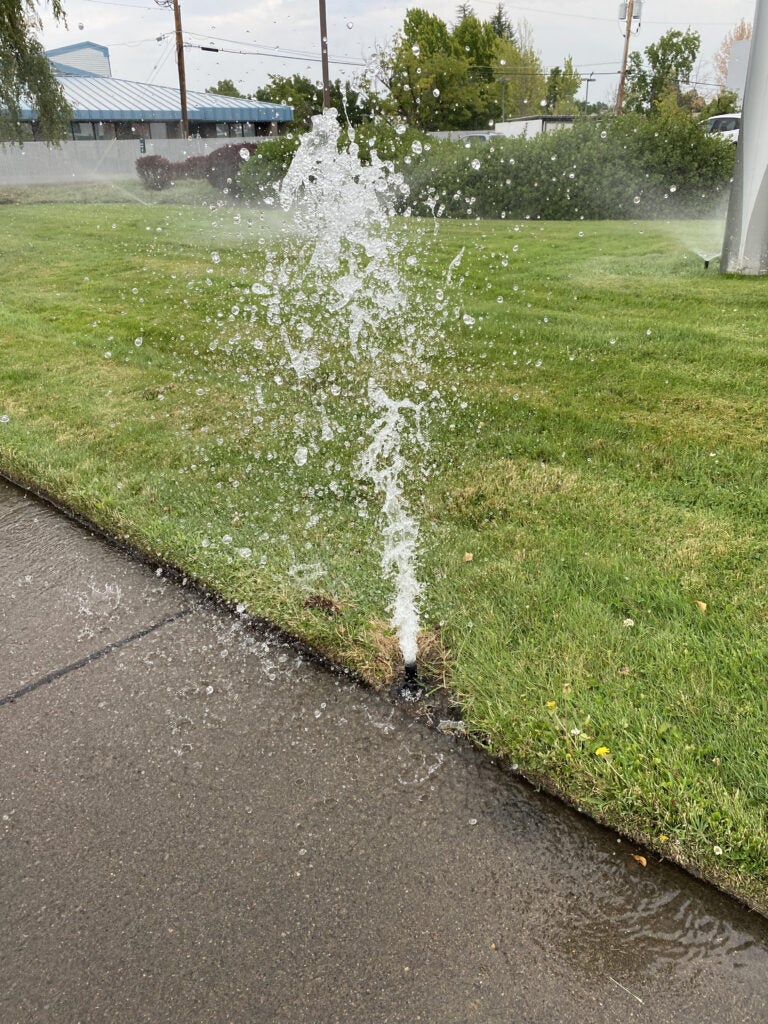
During a drought in Jackson County, customers play an important role in helping protect their community’s water supply. Small everyday actions, especially outdoors, can make a big difference. One of the most effective ways to use water efficiently outdoors is watering in the early morning or late evenings to prevent water waste due to evaporation, adjusting irrigation schedules to avoid overwatering, and making sure sprinkler systems aren’t watering pavements or running during rain events.
Read on for more tips or visit some of our Water Efficiency pages linked at the bottom of this page.
Love Your Water, Use it Wisely
It is important to remember the delicate balance between human activities and our region’s natural environment. Did you know that you can help play a role in helping to safeguard our water resources for essential drinking and public health purposes?
In our area, water usage triples during the summer months largely due to the increase in lawn and landscape watering. Love the water we have by making conservation a part of your daily life to help us to preserve these water supplies. Start with the following tips:
• Stop leaks. Check all water-using appliances, equipment, and other devices for leaks. Running toilets, steady faucet drips, and outdoor sprinkler systems are common sources of leaks.
• Provide only the water plants need. Adjust your irrigation controller routinely to make sure you are not overwatering. Go to medfordwater.org/infoline during the summer months to learn exactly how much water you need to apply each week based on current local weather trends. Better yet, install a WaterSense labeled smart irrigation controller; we even offer a rebate!
• Plant the right plants. Use low-water and drought resistant grass, plants, shrubs, and trees plants that are appropriate for our climate. Our water-wise gardening website (medfordsaveswater.org) highlights water-wise gardening concepts tailored to the climate of the Rogue Valley and includes hundreds of diverse photos providing a wide variety of attractive examples.
• Schedule a Free Sprinkler Survey. Medford Water offers free comprehensive sprinkler system evaluations to help you use water efficiently in your landscape. Call 541-774-2438 to schedule a survey.
• Replace old toilets. The major water user inside the home is toilet flushing. If your home was built before 1992 and you haven’t replaced your toilets recently, you could benefit from installing a WaterSense labeled model that uses 1.28 gallons or less per flush. We have a Toilet Rebate as well!
• Install WaterSense labeled faucet aerators and showerheads. WaterSense labeled products use at least 20% less water than standard models, while providing equal or superior performance.
Find out more about stopping leaks, our rebate programs, and how you can conserve water this summer at medfordwater.org/waterefficiency or by calling 541-774-2438.
Measure Your Household Water Usage
Take advantage of your online Watersmart account portal to track your water usage, check for leaks, and set high usage/leak alerts by logging in at services.medfordwater.org. If you need help, view our Step By Step Guide to Watersmart Features or call us at 541-774-2430.
County Drought Status
The Jackson County Board of Commissioners requested an emergency drought declaration from the state on April 1, 2026, and on April 24, 2026, Governor Kotek declared a drought emergency in Jackson County. Click here to see the Governor’s Executive Order.
According to the US Drought Monitor, most of Jackson County is experiencing severe drought (D2).
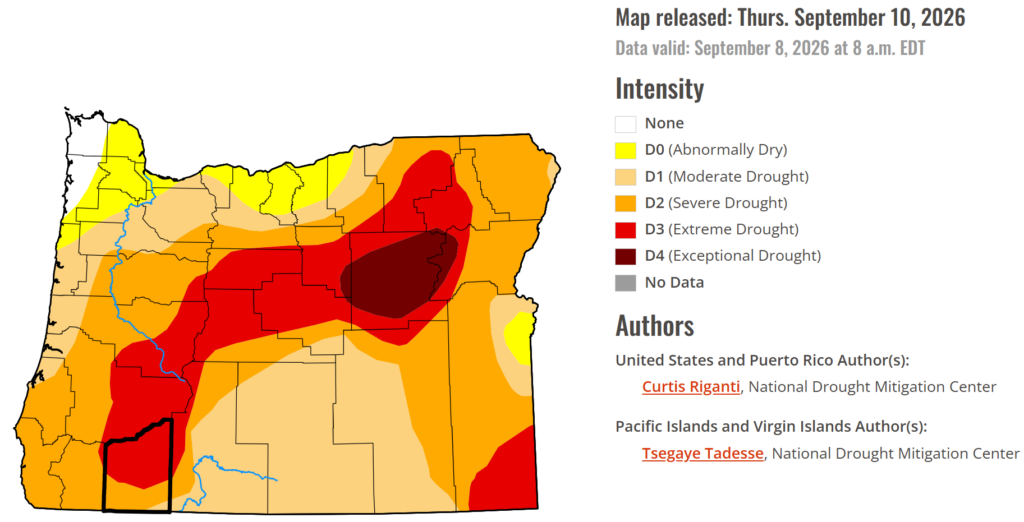
Source: US Drought Monitor
The drought declaration process typically goes through a three-part process before securing a state drought declaration from the Governor:
- First, a county commission submits a request for a state drought declaration to the Office of Emergency Management.
- Second, the Water Availability Committee, chaired by the Water Resources Department, meets to evaluate information on weather and water supply conditions and subsequently make recommendations to Oregon’s Drought Council. The Drought Council assesses the impact of drought conditions and makes recommendations to the Governor’s Office on whether to declare drought in an area.
- The Governor may then choose to issue an Executive Order declaring a drought emergency. State drought declarations are typically issued at a county scale. The primary benefits of a state drought declaration from the Governor are that it creates greater awareness of drought conditions, facilitates coordination between state agencies, and allows the Water Resources Department to provide existing water right holders with access to emergency water management tools.
The Governor or the Oregon Water Resources Commission can also direct state agencies and political subdivisions to implement a water conservation plan or water curtailment plan. Factors for declaring drought include precipitation, temperature, streamflow, reservoir levels, and soil moisture. A Drought Declaration provides greater awareness of drought conditions, access to emergency tools for water rights holders, short-term emergency authorizations (rather than permanent), and priority for drinking water and stock watering.
Additional Resources
Customers looking for more information about drought conditions and water use can visit several resources. For statewide drought declarations, current conditions, and water data, visit the Oregon Water Resources Department website at oregon.gov. Information about agricultural water availability can also be found through local irrigation districts serving Jackson County.
For more information on the local and regional water supply outlook, you can also explore some of these resources:
Medford Water’s Supply Outlook Frequently Asked Questions
Questions?
Call 541-774-2430 for more information.